Brick
Each wall holds a whole number of bricks. Each corner is one whole corner brick: its long side on one wall, its end on the other, swapping sides every course. Square corners only.
Tool · Tools tab
Cladding covers the walls of a house, or any upright part, the way a builder would. Whole corner bricks. Big cornerstones. Boards with a post at each corner. Logs that cross. Pick the walls, pick the material, press Apply. Rubble wall, coursed wall, brick, siding and logs, for models you can print.
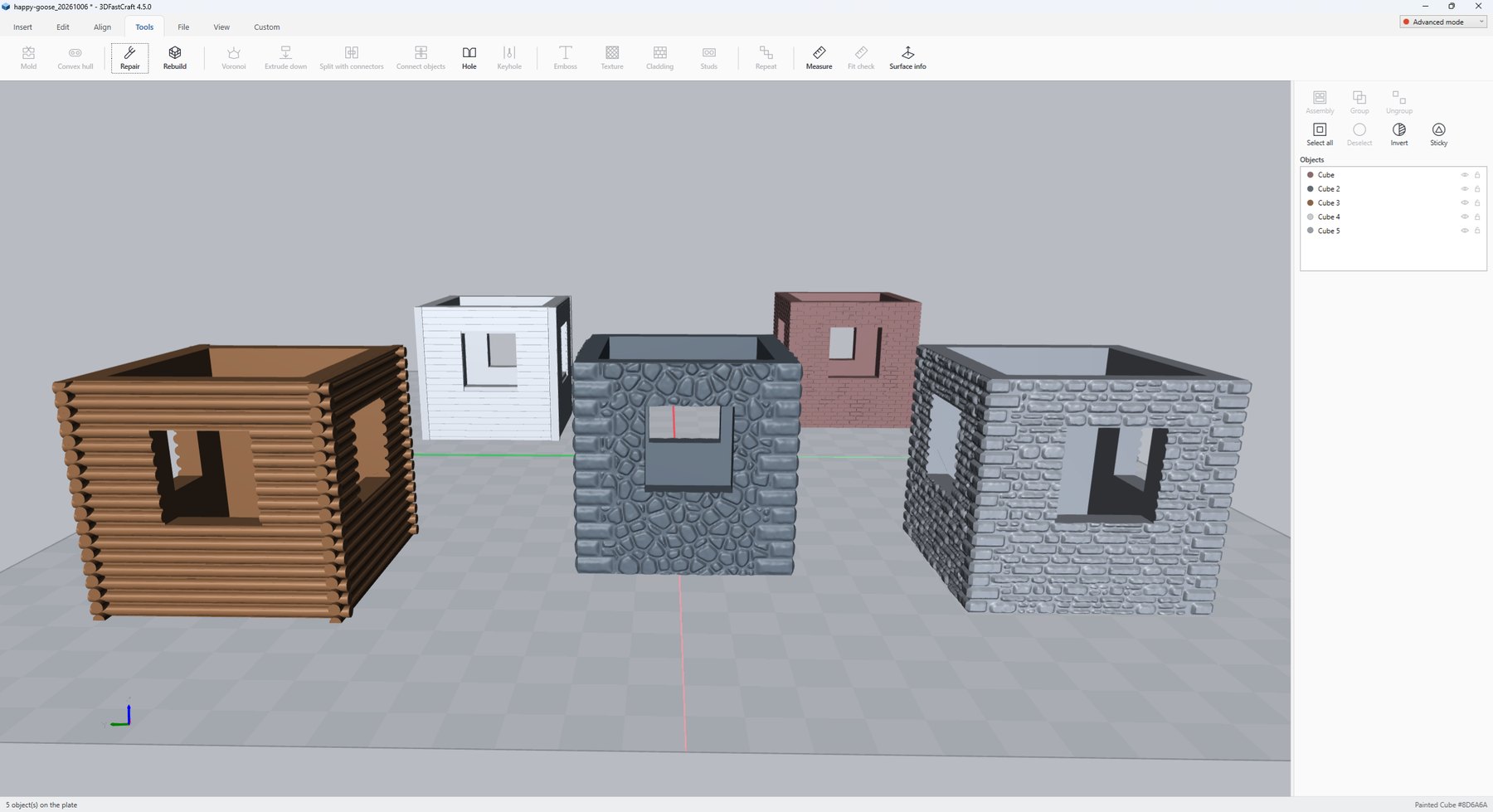
A pattern wrapped around a corner gets cut in two wherever the pattern lands. A real wall is not built like that. Cladding sets out each wall to the material and builds each corner as a corner.
Each wall holds a whole number of bricks. Each corner is one whole corner brick: its long side on one wall, its end on the other, swapping sides every course. Square corners only.
Big cornerstones at every outside corner, long and short by turns - the quoins of a stone house.
A post covers the board ends at every corner, inside and outside, as it does on a real house.
Logs cross at the corners and their round ends stand out. Every other wall is lifted half a log, so the logs take turns. Square corners only.
Openings already cut in the walls stay open. The cladding keeps off them.
The result is joined to the part and checked. If it would not be watertight, Cladding says so and hands your object back untouched.
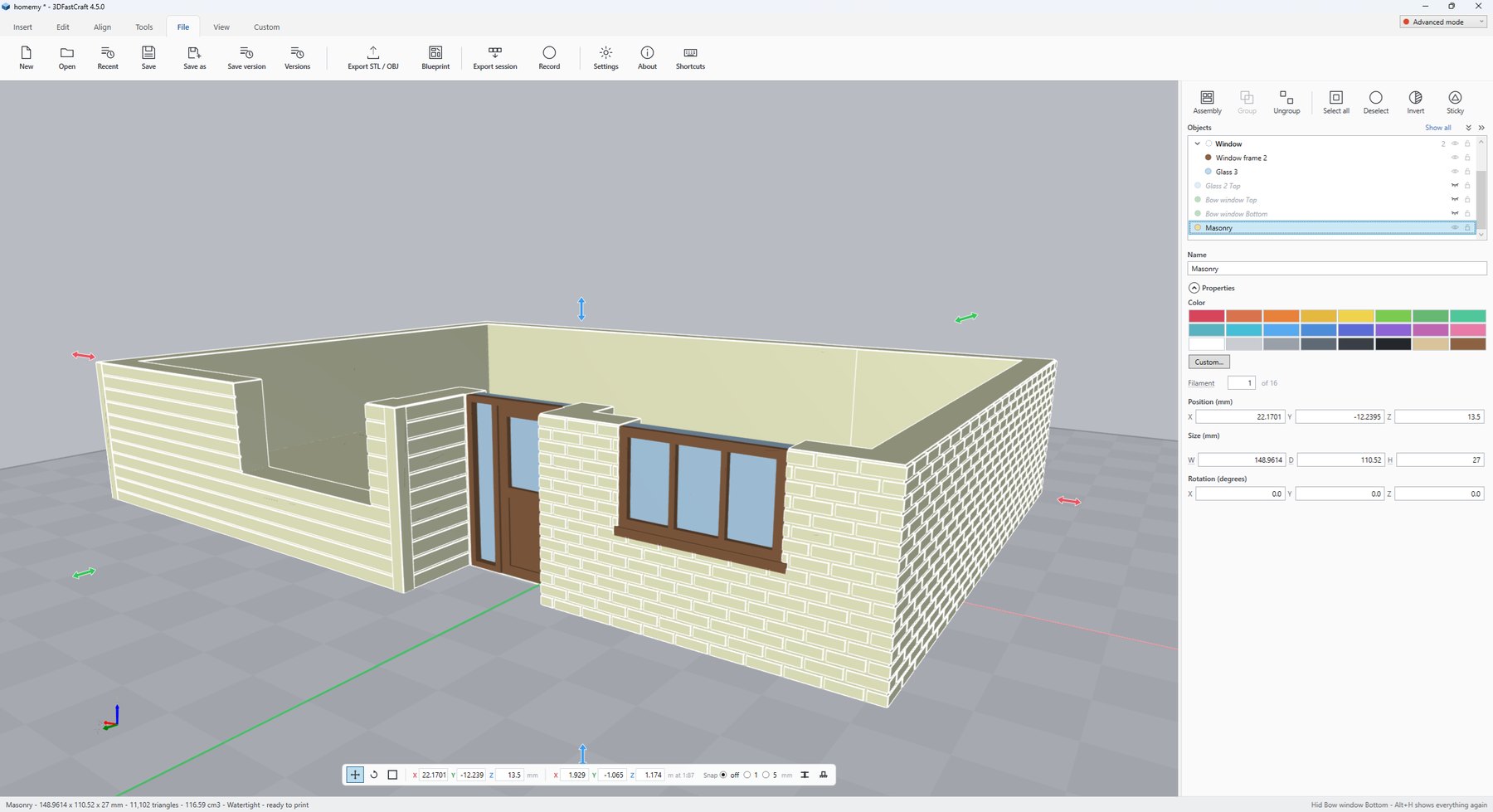
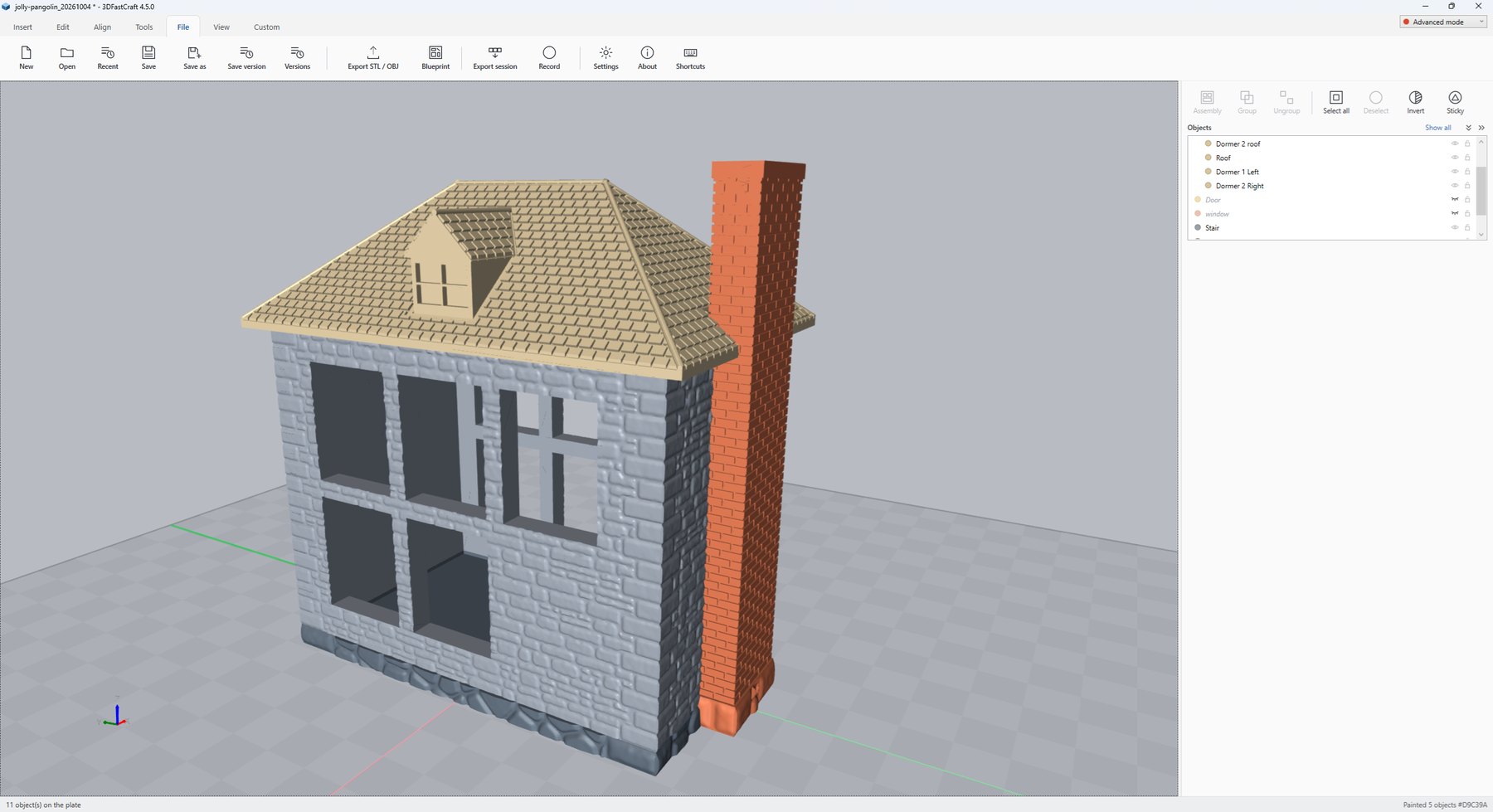
A model house built in 3DFastCraft. The walls are coursed stone on a rubble base, cut by Cladding around the windows. The chimney is brick. The roof, the dormer and the window frames come from the Library.
Each picture pair shows the same patch of wall. Flat is the pattern seen from above, dark where there is material. Relief is the same patch in 3D, lit from the upper left. The panel in the app shows both, live, as you change the numbers.
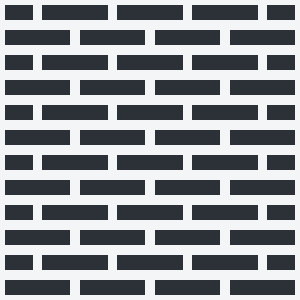
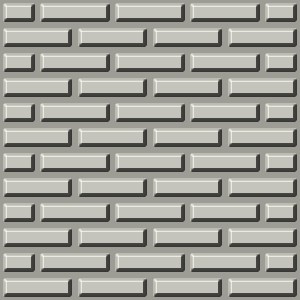
Running bond: level courses, the joints staggered by half a brick. Pitch is the length of a brick. Courses is how many times longer a brick is than it is deep - about 3.
Shown at pitch 6 mm, groove 0.8 mm, depth 0.8 mm

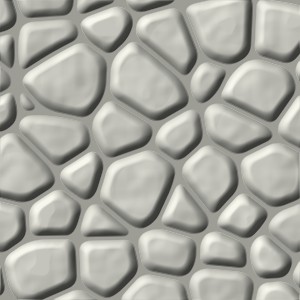
Rounded stones of every size and shape, set in mortar, like a field wall or a cottage. Pitch is the width of a stone. Groove 0 lets the stones meet.
Shown at pitch 8 mm, groove 0.6 mm, depth 1 mm
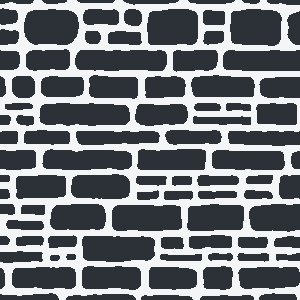
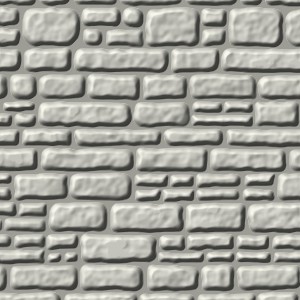
Squared, rock-faced stones in courses of uneven height. Each stone has its own length, and some are split in two thin ones. Pitch is the length of a stone.
Shown at pitch 10 mm, groove 0.6 mm, depth 1 mm

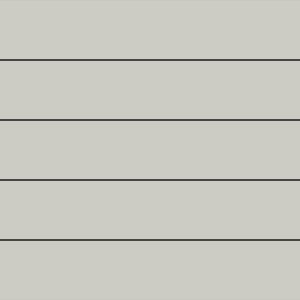
Lap siding: boards the whole way across, each one sloping out and stepping back. Pitch is the height of a board. The groove is 0 to begin with - the lap is the line.
Shown at pitch 4 mm, groove 0 mm, depth 0.8 mm

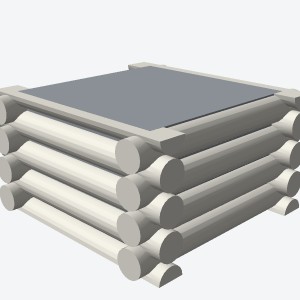
Round logs, one on another. Pitch is the thickness of a log, and Depth is how far each log stands out of the wall - at most half its thickness. The second picture is a corner.
Shown at pitch 6 mm, groove 0.6 mm, depth 2.5 mm
The size of one piece: a brick’s length, a stone’s width or length, a board’s height, a log’s thickness. Brick and log walls are fitted to a whole number of pieces, so the size you type is a close guide, not an exact one.
The gap between pieces: the joint between bricks or stones. At least 0.4 mm, one nozzle width - a narrower gap closes up as it prints. Siding, rubble and coursed wall can have none (0). Siding starts at 0.
How many times longer a piece is than it is deep. A brick is about 3. Rubble is about 1.3, coursed wall about 2.2. A bigger number gives longer, flatter pieces.
For siding: how far each board tilts out. 4 degrees reads as lapped boards at model size. 0 lays them flat.
How far the cladding stands out of the wall. Brick is usually 0.3 mm. Stone is 0.8 mm or more. For logs, how far they stand out.
A fine groove on a big wall means a fine mesh and a minute or two to apply. A coarser pitch or groove is much quicker. If a wall is too big for the numbers asked, the panel says so.
All 14 patterns of the Texture tool → · Download 3DFastCraft, free